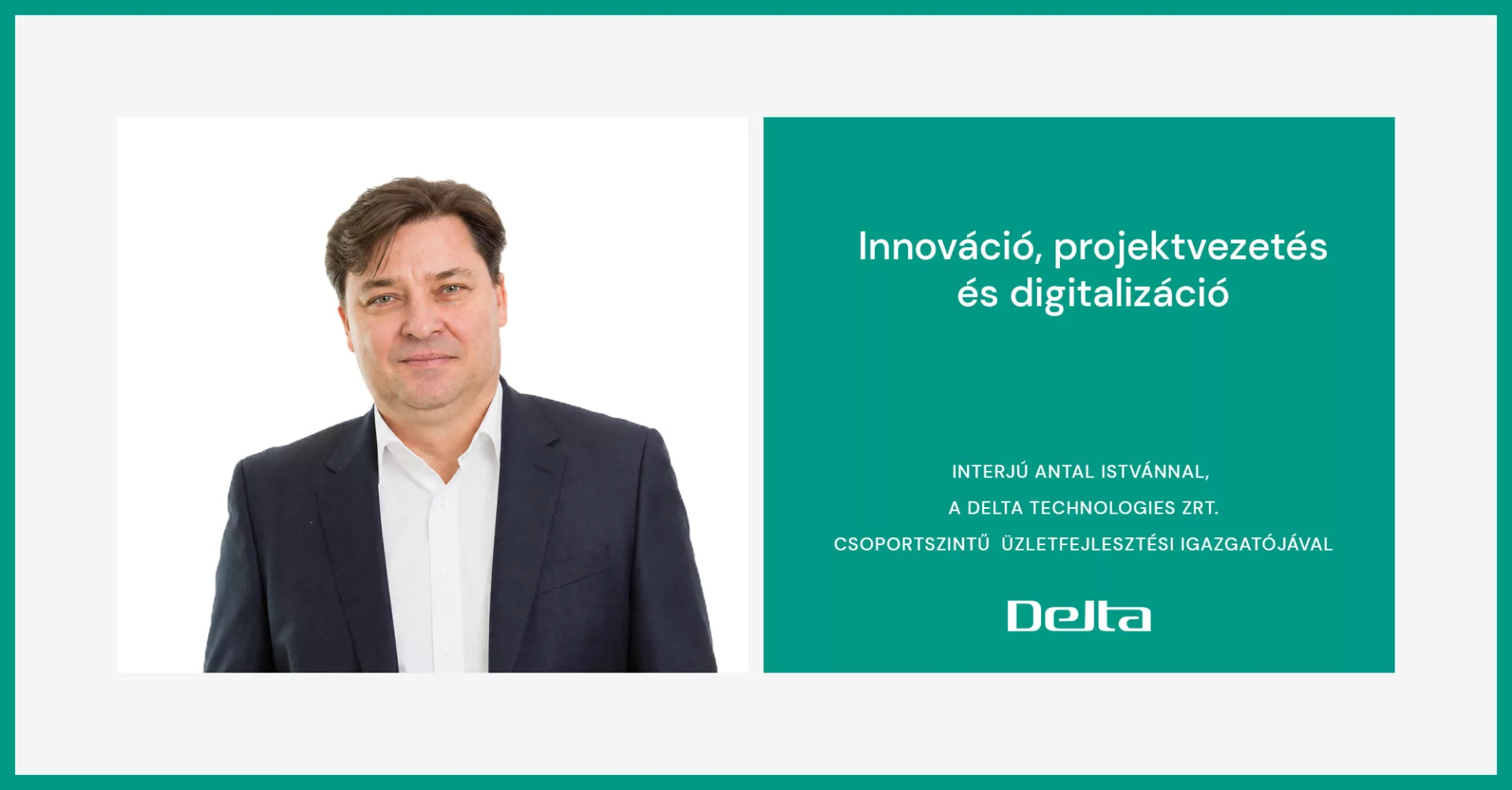

Innovation, project management and digitalisation
In the age of digital transformation and technological developments, one of the most significant domestic system integrator corporate groups cannot afford merely to follow industry trends. As leaders, we must proactively manage change, direct new projects, and occasionally create value outside our comfort zone.
István Antal, Group Business Development Director, has been a pillar of Delta for 32 years and is responsible for numerous multi-billion-forint projects. Now, he speaks first-hand about innovation, projects, lessons learned, motivation, and the state of digitalisation in Hungary.
What is your role in the organisation, and how do you define your responsibilities?
I work as Group Business Development Director, but most people find that I also like to simply call myself a „team member”. Not because I want to play down my responsibility, but because I believe that truly effective business development can be achieved when you are able to think together with partners and clients, rather than „just” negotiating as a director.
What is your main focus area, and what types of projects do you work on?
The large projects worth over one billion HUF belong to me, to us, whereas practically everything runs through the traditional project management directorate. Tasks that „stick out” from other portfolios, are too complex, novel, or simply do not fit within the framework of a traditional service, system integration, or product delivery, land with me. I also typically take on new, innovative areas, whether it is investments based on artificial intelligence, energy storage, or those requiring bespoke audiovisual solutions.
Where does each innovative project start? Who comes up with the idea?
It varies greatly, as the idea can come from a client or an internal colleague. The biggest challenge is the organisational culture itself: whoever makes the first move carries the whole innovation cycle through. It is common for a project to become my responsibility simply because there is no established standard for it on either the management or the service side. This also means that responsibility, knowledge acquisition, strategic thinking, and sometimes even execution fall to me.
What is special about your role within the organisation?
Within the company there is a vertical and horizontal division. However, the new areas require knowledge sharing, joint learning and taking responsibility, which is my role. Incidentally, many innovation projects develop organically; I start, get to know the given field – artificial intelligence, energy storage, management software – and simply see it through. Of course, this often sounds much simpler than it is.
You have been working at Delta for thirty-two years. What motivates you in continuously starting afresh, in the complexity?
I am driven by innovation and developments in my field. I have never been bored, because every 4 to 5 years a new challenge has always found me. This went hand in hand with career progression, greater responsibility, and, of course, the oversight of more significant areas. For me, it is crucial to always be learning something: with two engineering degrees, I look at problems as a technical person, but for a long time now, business acumen has also been needed to manage projects of this scale. Everyone in my family has been loyal to their employer, and I think that is partly in the genes.
How are successful projects born, and what works well?
Most projects are unique: out of 10 ideas, 2 are truly good, 6 are average and two are quite poor – these must be filtered out in time. Comprehensive oversight is essential in large projects: these projects cover every detail, potentially worth billions, in a complex manner, with a full lifecycle. The key to success is always knowing the team's performance capacity precisely, as well as knowing when to delegate what, and what to keep in my own hands.
How do you choose a team, and how do you manage any skills shortages?
Knowledge of the field and of people is crucial: when a project is launched in a completely new area, I try to involve those who can bring real added value and are keen to learn. Software development, for example, is a distinct field in this respect, as different personalities are needed for brainstorming, product development and implementation. Some people need to be selected quickly, whilst others need to be let go if they are simply holding the team back. In my experience, involving subcontractors is unavoidable on projects of this scale, which is why it is important that we also employ an in-house development lead, a project manager or specialist developers within Delta.
Let's look at a specific case; how did you implement the complex audiovisual project at the University of Veterinary Medicine?
That was indeed a fine and exciting task not so long ago. The concept came together there in three days, and we managed to put together a truly complex AV system. With our added value, we achieved an innovative result not only from a technical perspective, but also in terms of content, management and training. We similarly applied this approach most recently to a software development project as well: every major project involves tenders, EU funding, deadlines and complex administration. Choosing the team is the hardest part, because there is a constant shortage of developers, subcontractors are indispensable, yet the organisational logic today still aims to strengthen our own high added value.
What are the areas where there is no market pressure, yet there is still development or innovation?
There is currently no overriding technological imperative on the IT market like there was in the era of Windows XP, Windows 7, or the smartphone boom. Projects are now driven rather by minor administrative developments in digitalisation, and serious competitive pressure, mandatory hardware replacement cycles or mass system outages are not typical for us. The importance of digitalisation lies in how individual processes (billing, record-keeping, permission management) can be handled in a truly electronic, fast, transparent, workflow-based way, rather than with a piece of paper thrown onto a desk. It is worth improving efficiency even with small steps.
Where does Hungarian digitalisation actually stand today?
Even at large corporations and institutions, system-level digitalisation is still lacking, and the predominance of paper-based processes remains significant. Despite the existence of digital archives or software, workflows—such as signing, approval and accounting—are still mostly manual and paper-based. The transition could also be faster in the public sector. Significant progress is only being made where there is motivation and support for digitising processes. Many companies are afraid of innovation, even though corporate capacity and infrastructure would be ample; rather, a lack of a change in mindset is slowing down the breakthrough.
How do you view artificial intelligence? Is AI a real opportunity, a threat, or just hype?
Artificial intelligence in itself does not threaten jobs, especially where there are no properly digitised core processes, document management or data assets at all. AI will be most effective in companies that are already digitally organised and have structured databases and automated workflows. In industry, AI can mean a real competitive advantage, but in the administrative field, it is for now more of a talking point. In many places today, basic ERP or registry systems are still missing, so AI can only be useful if the basics are already in order, and the market still has plenty of work to do in this regard as well.
What are you most proud of in your career so far?
To the fact that we always manage to introduce innovative solutions at Delta. With new areas and projects, I have never been bored, and I have never seriously thought it would be worth going elsewhere. I have always found challenge and excitement. The fact that I have been working at the same workplace for thirty-two years is not the result of habit, but a sign that the environment is constantly changing and evolving, and I am able to change along with it.